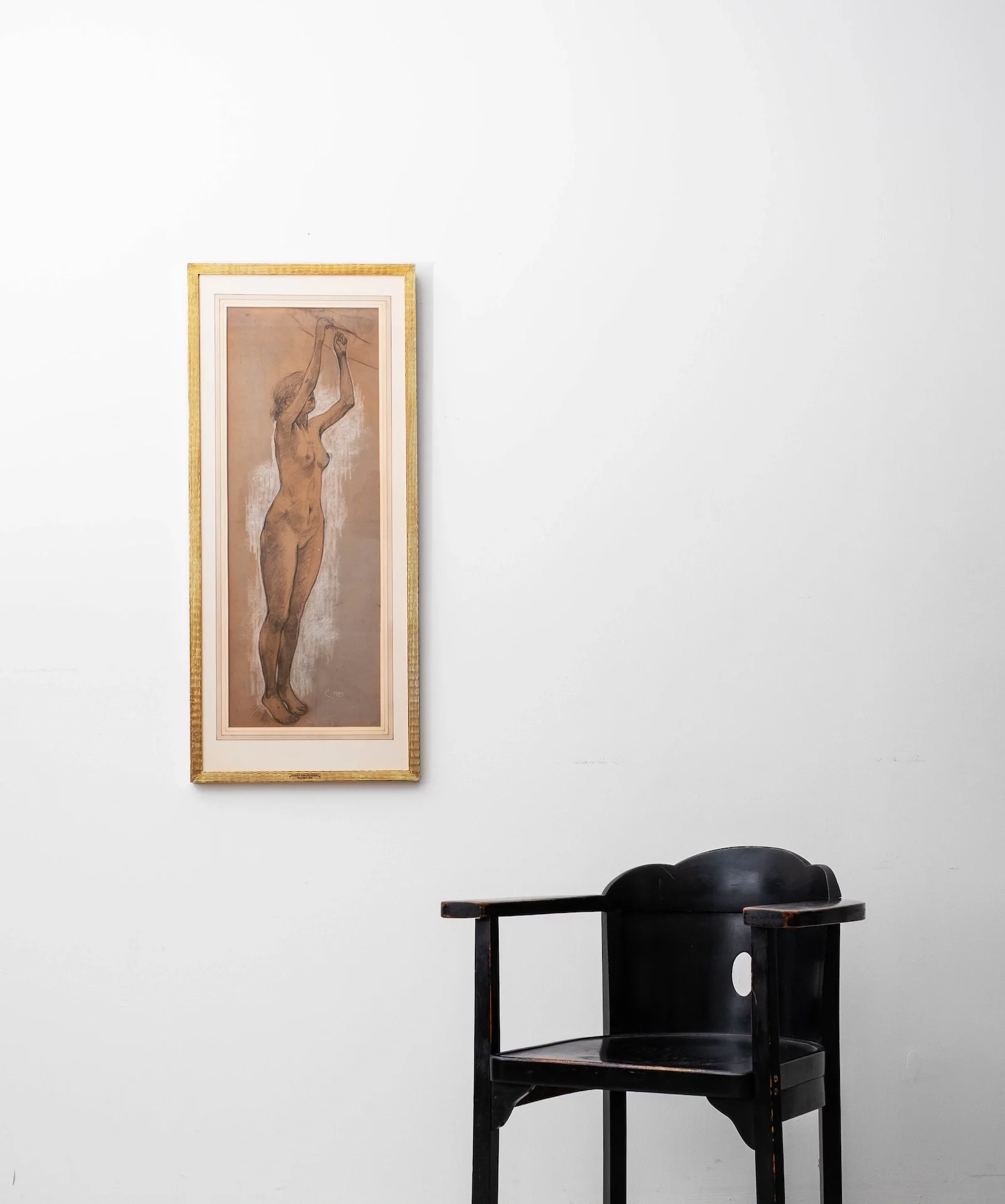
Secessionist Drawing, Female Nude by Engelhart
sold€12.900,00
Paintings
- artist
- Josef Engelhart
- period
- 1893
- materials
- Chalk, charcoal, paper, passepartout, wood (gilded), glass, brass
- technique
- Mixed media
- dimensions
- 105,3 × 46,3 × 2,6 cm
- condition
- Good
- culture
- Vienna
- provenance
- Private collection (1010 Vienna)
Original Secessionist drawing (study), female nude "Cherry Picker" by Josef Engelhart (Vienna, 1893). The present work by Josef Engelhart from 1893 is to be understood as a study for the main work "Cherry Picker". The associated painting was publicly presented in 1909 in the 34th exhibition of the Vienna Secession and destroyed in the Second World War. At least two preliminary studies for this composition have survived; another is now in the collection of the Albertina. The present sheet is thus to be classified as an independent study within this work process and gains additional art historical significance due to the loss of the main painting. Pictured is a standing female nude in side view with raised arms, in a calm, almost statuesque pose. The figure is set against a warm-toned, brown-primed paper, which gives the sheet a closed, earthy-muted overall effect. The execution takes place in a mixed technique typical of the time: black chalk or charcoal is used for the linear layout and the modeling of the body shapes, while white highlights emphasize the light parts and bring out the plasticity of the figure. Partially blurred transitions indicate a conscious rubbing of the material, creating soft modulations between light and shadow. This technique corresponds to the academic nude study of the late 19th century, in which the brown paper functions as a midtone, while black defines the shadows and white the lights. The body is thus built up exclusively via chiaroscuro contrasts, which gives the representation a clear, plastic presence. The sheet was created in an early, artistically formative phase of Engelhart's work. Since 1883 he had been a member of the Hagengesellschaft, one of the most important progressive artists' associations in Vienna before the Secession. Engelhart is one of the central figures of Austrian art around 1900 and in 1897 he was a co-founder of the Vienna Secession, the movement that marked the break with the conservative Künstlerhaus and decisively advanced modernism in Vienna. Within this upheaval, Engelhart plays a key role: While artists such as Klimt or Moser took more decorative-symbolist paths, Engelhart remained committed to the figurative and a lifelike conception, often influenced by French Impressionism. His works combine academic rigor with an increasingly free, lively treatment of body, movement and everyday scenes. Especially his early works impressively show the transition phase between traditional training and modern artistic conception. As a chronicler of Viennese life and as a formative personality within the Secession, Engelhart made a significant contribution to the development of Austrian modernism. His importance lies not only in his own oeuvre, but also in his active role within the artistic community, which made Vienna one of the most important centers of European art around 1900.