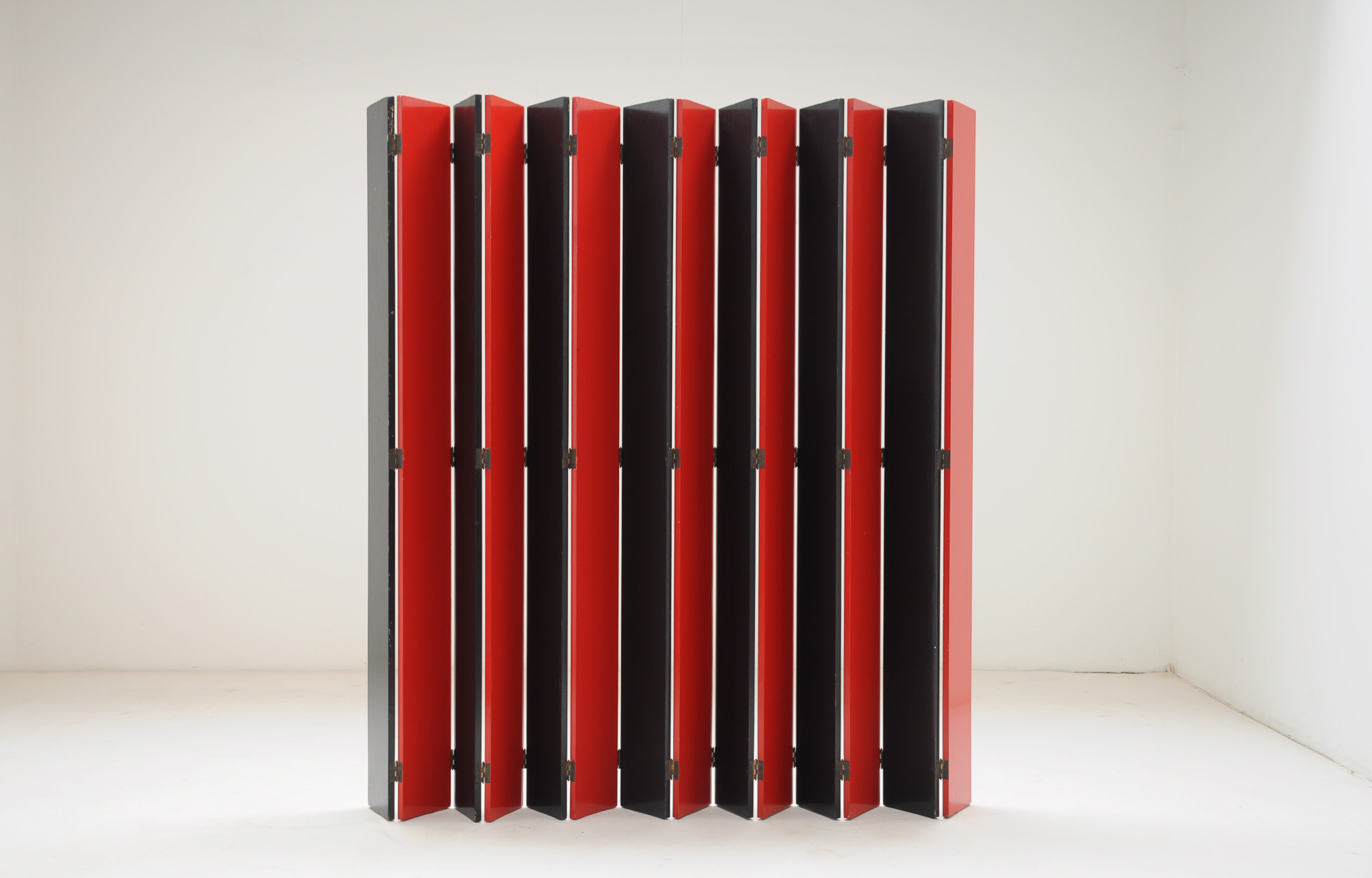
Emiel Veranneman folding screen, 1960
availablePrice on request
Other furniture
- period
- 1960
- materials
- Lacquered wood and mixed materials
- dimensions
- 185 × 249 cm
This unique folding screen was designed and executed by Emiel Veranneman in 1960 as a site-specific commission for Au Riz Doré, a macrobiotic restaurant in Brussels that functioned as an intellectual and artistic meeting place during the early 1960s. The object belongs to a rare group of works in which Veranneman translated his modernist and architectural thinking into autonomous sculptural furniture. Far from being a decorative element, the screen operates as a spatial instrument: it structures space, modulates light, and introduces rhythm and proportion through its material presence. Executed in lacquered wood and mixed materials, the screen reflects Veranneman’s conviction that art, architecture and design should form a coherent whole. This vision places the work firmly within the post-war Belgian avant-garde, where artists sought to dissolve traditional boundaries between disciplines. During the late 1950s and early 1960s, Veranneman developed a practice that moved fluidly between painting, relief, architecture and interior design. Commissions such as this folding screen illustrate his belief in the artwork as an integrated element of daily life, rather than an isolated object. Au Riz Doré was a particularly significant context: inspired by the ideas of Japanese macrobiotics and frequented by artists, intellectuals and architects, it provided an ideal environment for Veranneman’s holistic approach. The present screen stands as a rare surviving example of this synthesis between modernist art, social space and architectural function.