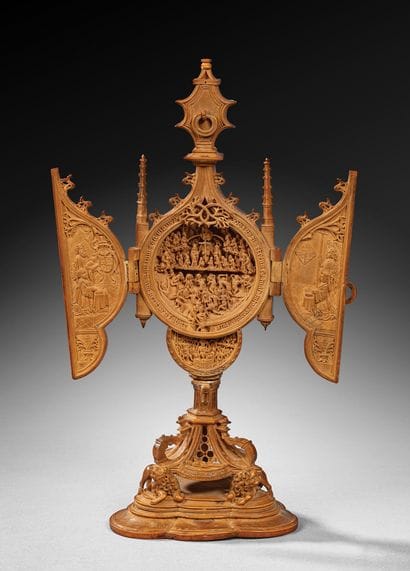
Boxwood Micro-Sculpture Triptych: The Last Judgment
on auctionPrice on request
Haute Époque et Curiosités
Sculptures
- period
- Early 16th Century
- materials
- Boxwood, leather
- dimensions
- H. 22.5 cm - W. (open panels) 14 cm
- condition
- Left pinnacle and one console redone, slight accidents and restorations, small loss to the case.
- culture
- Dutch
- provenance
- Private collection, Brittany
Triptych, boxwood micro-sculpture depicting the Last Judgment. Central part: circular in shape with an accolade-shaped upper part with hooked ramps, furnished with intertwined branches symbolizing the crown of thorns, flanked by Gothic pinnacles and topped with a rhomboid pediment with a scalloped outline fitted with a movable ring; lunula at the lower part. The Last Judgment scene features several deep planes animated by numerous figures in the round or semi-round. The Celestial Tribunal at the top with Christ the Judge enthroned in majesty on an arc, surrounded by ten angels carrying the Instruments of the Passion, the one with the Cross below him, and framed by the twelve Apostles; on the horizontal line symbolizing the separation of the Elect and the Damned are depicted the crowned Virgin and Saint Joseph holding the lantern, at their feet extends a procession of sixteen kneeling saints among whom are recognized Mary Magdalene, Saints Lawrence, Stephen, and James; to the left and right, the trumpeting angels blowing trumpets announcing the awakening of the dead. Further down, the naked Damned writhe and despair, men carrying their bags of gold personifying the sin of Avarice, women with loose hair that of Lust, some chained are dragged to Gehenna by demons, another is bitten by a monster; at the lower part, a female demon casts a fallen soul, making it pass through the gate of Hell through the circle of the frame; this, delimited in a semicircle, represents a furnace with, in the center, a devil standing in a cauldron amidst the damned, surrounded by flames devouring others, gesticulating or lying on grills. Inscription in Gothic letters bordering the central panel: to the right of Christ, Gaudia uos iusti nunquam peritura subite ("You, the righteous, enter into joys that will never perish"); to his left, Vos angis aeternum coquat intolerabilis ignis ("You, serpents, may the intolerable fire burn you eternally"). Lateral panels sculpted in bas-relief representing the couple of patrons kneeling before a prie-dieu accompanied by their coats of arms and their respective patron saint, fleuron at the lower part. Left panel: Jean Caulier (circa 1455/1460-1533), Saint John the Baptist at his side, holding the book on which the Lamb lies, quartered coat of arms, 1 and 4 [azure] with three currycombs [silver] with a border [gold]; 2 and 3 [gules] strewn with lilies [gold]. Right panel: Hélène Le Tailleur († after 1547), second wife of Jean Caulier, Saint Michael at her side wearing armor and holding a cross, coat of arms split bearing to the dexter the arms of her husband and to the sinister a quartered, 1 and 4 [silver] with a bend [azure] charged with three flying pigeons [gold], 2 and 3 [sable] strewn with lilies [gold]; over all an escutcheon [silver] with three lions [sable]. Right panel fitted with a movable ring. Pierced foot resting on a base with a scalloped edge, upper register with a triangular and trilobed plan, with three flanked consoles, a transi resting on one of the lobes, bordered by the inscription in Gothic letters hac pie pastor que ducad ovile suum ("here, may the Good Shepherd lead him who is of his flock"); this base is supported by three reclining lions, their front paws folded, the hindquarters raised with the tail passing underneath against their flank. With its original embossed leather case with lozenge decoration, loops, and straps. Holland, Delft, circa 1520/1525. H. 22.5 cm - W. (open panels) 14 cm (left pinnacle and one console redone, slight accidents and restorations, small loss to the case). This lot benefits from an export certificate for cultural property.