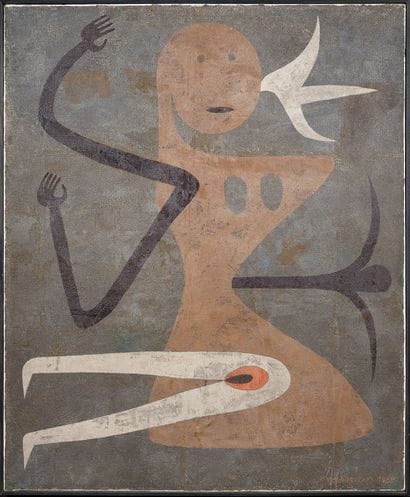
Croissance
on auctionPrice on request
Tentation°3
Paintings
- artist
- Victor Brauner
- period
- 1960s
- technique
- Oil on canvas
- dimensions
- 73 x 60 cm
- provenance
- Galerie le Point Cardinal; Galerie Brimaud; Private collection
Victor Brauner, a Romanian-born surrealist painter naturalized French, went through a phase of profound artistic maturity in the 1960s, where his work became more esoteric, symbolic, and imbued with spirituality. By this time, Brauner already had a well-established career. He was recognized in surrealist circles, even though he officially broke with André Breton's group in 1948. Like Roberto Matta or Simon Hantaï, Victor Brauner only achieved the fullness of his art by moving beyond Surrealism, to which he adhered for its ethics rather than its ideology. This painting, created in 1962, likely in Varengeville in Normandy where he had settled a year earlier, is part of a body of work exploring the theme of creative fertility and the primitive myth of origins. Blending evocative forms and unified blocks of color, the dreamlike force emanating from it makes it a wonderful example of this strange and fascinating world, populated by significant creatures and a mirror of an archaic unconscious that Brauner continuously brought to light throughout his work. This high-quality painting was presented by Galerie du Point Cardinal, founded by Jean Hugues, a gallerist, publisher, and bookseller, whose intellectual rigor, discipline, and deep passion for art and literature were universally recognized. In the 1960s, his palette darkened or became more muted, yet remained vibrant at times with earthy colors, deep reds, dark blues, and golden yellows. Forms simplified, tending towards archaism, sometimes hieraticism. This was also a period of recognition. Breton dedicated an important text to him, "Entre chien et loup," in the "Cahiers d’art" review in 1946 (which did not prevent him from excluding Brauner from the group two years later…). He exhibited at Pierre Loeb in Paris and Alexandre Iolas in New York. His notoriety grew to the point that he represented France at the Venice Biennale in 1966, the year of his death. In "Croissance," we find most of the artist's recurring motifs: • The androgynous-mythological silhouette, extremely simplified, almost floating. • The single eye (or its variants), often linked to his own past injury but also to concepts of inner vision or esoteric knowledge. • The bird, a frequent motif in Brauner's work, often carrying a message or spiritual elevation. • The palette is sober but dense, with matte contrasts and a texture that appears almost mineral. This type of composition evokes the idea of a coded language, as if he were painting hieroglyphs of an inner world, somewhat like Miró but with a more mystical gravity.