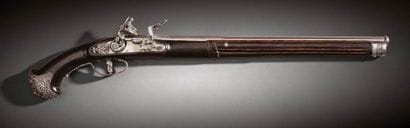
Flintlock Pommel Pistol by Giovanni Valetti
on auctionPrice on request
Collection Philippe Missillier
Arms & Armour
- artist
- Giovanni Valetti, Lazarino Cominazzo
- period
- circa 1660-1670
- materials
- Iron, blackened wood
- dimensions
- L. 65 cm (barrel L. 47 cm), Cal. 12 mm
- condition
- Excellent but the upper jaw of the hammer has been replaced.
- provenance
- Part of a pair that belonged to King Louis XIV, included in the inventory of the Royal Arms under number 372 from 1717. The second pistol forming a pair is preserved in the Hermitage Museum in Saint Petersburg.
Flintlock pommel pistol with two superimposed barrels and concealed second shot, by Giovanni Valetti, Brescia, circa 1660-1670, part of a pair that belonged to King Louis XIV, included in the inventory of the Royal Arms under number 372 from 1717. Length 65 cm (approximately 2 feet, the royal foot being 32.48 cm). Barrel length 47 cm. Caliber 12 mm. Italy, Brescia, Giovanni Valetti and Lazarino Cominazzo, circa 1660-1670. Flintlock pommel pistol, with double superimposed barrels, octagonal then round, upper barrel ending in a bolster, bearing the signature GIO LAZARINO COMINAZZO, bombé lock plate, signed GVB (Giovanni Valetti Brescia), chiseled with foliage and ending in a fleur-de-lys, hammer in the shape of a chimera, double sliding pan chiseled en suite, pan cover adorned with a mascaron, mainspring, two-part blackened wood stock, stamped 372 in front of the trigger guard, all iron fittings chiseled and openwork with foliage, fleur-de-lys pommel button. Ramrod concealed under the barrel block. Condition: Excellent, but the upper jaw of the hammer has been replaced. This pistol is an exceptional weapon due to its technical and historical characteristics. From a technical point of view, it is distinguished by the ingenuity of its mechanism which allowed two successive shots to be fired while revealing only one barrel, the lower barrel being hidden by the stock, and a single lock plate subtly equipped with a double sliding pan, which made the possibility of a second shot unpredictable. Weapons with this concealed system of successive firing, using a single lock plate and a hidden barrel, from the last third of the 17th century, are extremely rare. Indeed, only two other examples are known: a pair preserved in the collections of the Princes Odescalchi Rome (cf. N.di Carpegna, Firearms in the Princes Odescalchi Collection in Rome, Rome, Ed. Marte, 1975, p97-100, n° 23 (Inv.n° 62-3)) and another in the Capodimonte Treasure in Naples (Cf. Tesori di Capodimonte, Dipenti, Disegni et Oggetti Lombardi dal Museo di Capodimonte di Napoli, Milan, Ed. Silvana, p. 106-107 (Inv. N° OA 1907,3873-3874)). From a historical point of view, the presence of the number 372 stamped in the stock in front of the trigger guard refers directly to the General Inventory of Crown Furniture of 1717 (Arms and Armor) drawn up by Gaspar de Fontanieu, Comptroller General of Crown Furniture, in which is described: «372...A pair of pistols two feet long with two barrels and a single battery, made by the same PIO LAZARINO COMINAZZO, mounted on blackened wood, the end of the pommel being of polished openwork chiseled iron». The first inventory, carried out in 1673, comprising 351 numbers (including the famous Arms Cabinet of Louis XIII) as well as its supplement of 1681 did not mention this pair of pistols, which indicates that it was still among the weapons for the use of King Louis XIV, before joining the 1717 inventory. The second pistol forming a pair is preserved in the Hermitage Museum in Saint Petersburg. It is published and inventoried under number 6659 (Cf. L.Tarassuk, Antique European and American Firearms at the Hermitage Museum, 1972, p. 195, n° 409, as well as in JP Reverseau, Armes et Armures de la Couronne au Musée de l'Armée, Dijon, Ed. Faton, 2004, p. 292). Despite the delicacy and refinement of the treatment of the fittings, in openwork chiseled iron, fleur-de-lys pommel buttons, the functional and robust appearance of this pair of pistols reinforces the hypothesis of their use by King Louis XIV himself. Furthermore, their rare technical particularity is reminiscent of that of the famous set, composed of two wheel-lock pistols and a carbine (Livrustkammaren of Stockholm) executed by Giovanni Antonio Gavacciolo (lock plates), Lazarino Cominazzo (barrels), Antonio and Carlo Gossi as well as Giacinto Cecardo (fittings), in 1638-1639, offered by the Senate of Venice to Louis XIII, then given either by the Queen Mother Anne of Austria or by Cardinal Mazarin to the Crown of Sweden. The reassembly of the mechanism by the action of the hammers, a complex and original system, only enhanced the importance of a gift with diplomatic resonances. The hypothesis of a new diplomatic gift from Italy, during Mazarin's period of influence, is plausible.