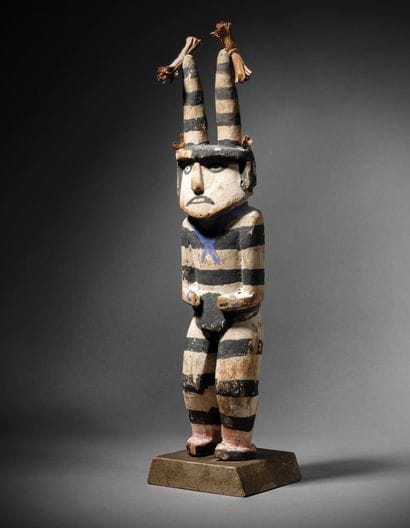
Clown Hano – Koshare Kachina Figure
on auctionPrice on request
LES KACHINAS DE LÉO SCHEER
Ethnographic & Tribal Art
- period
- Early 20th Century
- materials
- Carved wood (cottonwood root), natural pigments, plant fibers
- dimensions
- H. 28.5 cm (without base or fibers)
- condition
- The condition of the objects is noted to the best of our ability and is mentioned in the catalog for informational purposes only. Items are sold in their current state at the time of sale. The absence of a mention in the catalog does not imply that the lot is in perfect condition or free from restoration. Dimensions and weights are indicative. A prior exhibition allowed for examination of the pieces described in the catalog; no claims regarding their condition will be accepted once the hammer falls and the object is delivered. Upon request, a condition report can be provided for lots estimated over €1,000.
- culture
- Hopi, Arizona
- provenance
- - Collection Claude Lévi-Strauss (1908-2009), Paris - Sale collection C. L.-S., June 21, 1951, Hôtel Drouot, Paris (auctioneer: Maurice Rheims assisted by Charles Ratton), lot 36 - Collection Jacques Lacan (1901-1981), acquired at the above sale - Loudmer Sale, «Arts Primitifs - Poupées Kachina des Indiens Pueblos provenant de la Collection Jacques Lacan», Drouot, Paris, June 27, 1991 lot 4 - Collection Edith and Roland Flak, Paris - Collection Léo Scheer & Nathalie Rheims, Paris, acquired from the previous owners in 2003
This 28.5 cm high Hopi statuette is carved from a cottonwood root and adorned with natural pigments on a lime background. The figure stands with slightly bent legs in a dynamic posture. Its face, with large questioning eyes, is naturalistic and topped with a headdress featuring two horns decorated with plant fibers, likely dried corn leaves. The costume is striped with horizontal black and white bands. A necklace and bracelets are painted blue, and the boots are highlighted with red pigments. The loincloth is sculpted in volume, as is the chignon at the back of the head. The sculptural characteristics (proportions, posture, slight lateral torsion of the upper body, naturalism of facial features) correspond to ancient Hopi art canons. This sculpture can be dated to the very early 20th century, perhaps even earlier, aligning with the oldest known Kachina sculpture styles, with the first recorded examples dating back to the 1870s-1880s. This figure is known by several names in the Hopi pantheon: Clown Koshare, Glutton Hano, Koyala, or Paiyakyamu. It is a character of Tewa origin (Rio Grande Pueblo group) whose adoption by the Hopi likely dates back to the period following the Pueblo Revolt of 1680 against the Spanish invaders. As Barton Wright indicates in Esprit Kachina (2003), Koshare clowns are not Kachinas (Katsinam) per se; they entertain the public during ceremonies. However, they are also, and above all, guardians of traditions: they mock and ridicule behaviors that do not conform to tradition. They always perform in groups and are noted for their antics and gluttony. Clowns, in addition to the theatrical and comical nature of their appearances, allow the Guardians and Warriors to maintain order and embody justice and wisdom. Guardians often prevail, but sometimes Clowns rout them, causing disorder and confusion at the heart of the ceremony. This is not by chance and corresponds to the symbolic, choreographed illustration of flaws inherent in human nature. Indeed, for the Hopi, the community of Kachina spirits resembles that of humans: some members aspire to conform to the established order, while others constantly bend or break the rules. Far from being regarded with contempt, Clowns are respected, feared, and admired. These “Masters of Disorder” represent what Roger Caillois called “the sacred of transgression” (L'Homme et le Sacré, 1939). During his stay with the Hopi in 1945, André Breton attended several Kachina ceremonies, including Clown dances (the Koyala gluttons) on Saturday, August 25, in the village of Mishongnovi on the Second Mesa.