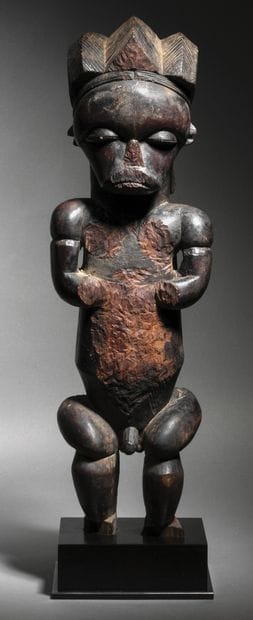
Byeri Reliquary Figure, Fang Mvai
on auction120.000 - 150.000 EUR
TENTATION°2
Sculptures
- period
- Pre-1850s
- materials
- Wood with brown oozing patina
- dimensions
- H. 48 cm
- culture
- Fang Mvai, Northern Gabon
- provenance
- - Transmitted by descent, - Collected in situ by a logger, Gabon, between 1929 and 1940.
Dispersed along the Ntem River, in northern Gabon, the Mvaï form a small group whose works are considered the essence of Fang art. They were first mentioned by the German explorer Günter Tessmann in his remarkable ethnographic monograph, Die Pangwe, published in 1913. With a strong aesthetic combined with great power, the statues attributed to the “Masters of Ntem” according to specialist Louis Perrois, were sculpted before the 1850s. Considered the jewels of Fang art, these works remain rare. In Mains de maîtres in 2001, five male sculptures were attributed to these masters. The first, from the former Paul Guillaume collection, is currently preserved at the Brooklyn Museum. Another, very similar, is in the Dallas Museum. The other three remain in private hands. To this restricted corpus are added two works preserved at the Rietberg Museum and the Seattle Museum. Such artistic talent is not given to all sculptors. This corpus shows the dexterity and high quality of execution of these masters. As in the artists' workshops of the Quattrocento, they probably worked together and influenced each other. “The Guerre, Ginzberg (Dallas) and White (Seattle) sculptures are very probably by the same hand, so clear are the formal similarities, including in the details of sculpture, to the point that the analytical description of one applies perfectly to the other two,” writes Louis Perrois. They have the same brown, polished and beautifully patinated surface. The elaborate hairstyles, the expressiveness of the faces, the prodigious segmentation of the body, the fan-shaped stylization of the hands and the ventral scarifications are very similar. This rediscovered sculpture is part of the Fang Masters of Ntem group. Although having suffered material loss, this eyema byeri retains all its power and severity. Crowned with a majestic three-lobed hairstyle, the face is remarkably modeled. The coffee bean eyes offer a beautiful expression of serenity. Below the nose, the mouth is skillfully projected forward, creating an incredible pout. The neck is short and powerful. The shoulders, pectorals, arms and forearms are sculpted in roundness. The hands were undoubtedly joined at the abdomen, and probably held an offering receptacle. The long cylindrical torso is characteristic of the Mvaï style. The legs, all in curves, are skillfully sculpted and modeled. A testament to the virtuosity of Fang artists, this statue is distinguished by the subtlety of its modeling, the majesty of its hairstyle, and the exceptional geometry of its shoulders. Within the very narrow corpus of works by the “Masters of Ntem”, this rediscovered work is remarkable. This large male byéri, despite the ravages of time, perfectly embodies the excellence of the great Fang Mvaï art and its masters located on the course of the Ntem, a river that today marks the border between Gabon, Cameroon and Equatorial Guinea. According to old collection indications, it would seem that there was in this region, current Woleu-Ntem, an exceptional sculptural center of rare homogeneity, both in the essence of the woods, the patinas and the stylistic characteristics: general morphology and over-ornamentation. The similarities of the few examples known to date are such, and this one is added to the previous corpus, that it seems admissible to attribute them to the same sculptor, although unfortunately to this day his identity remains unknown. So let's mention the byéri mvaï from the old collections: Pierre Guerre, Helena Rubinstein, Marc Ginzberg, and Paul Guillaume, current Jim Ross collection in New York, all listed by Louis Perrois in his catalog of the 1992 Marseille exhibition: Byéri Fang, Sculptures d'Ancêtres en Afrique. These byéri wear the same hairstyle with three strong braids, more or less falling on the nape of the neck, faces with broad foreheads and coffee bean eyes adorned with a small trade bead. The mouths form a unique Pahouin pout that is easily identifiable. The bodies are solid and short, perched on bent legs according to the ritual position that allows the statue to be placed on the reliquary box with the fixing rostrum. The position of the hands is also classic in this style, we guess that on our byéri it was identical although it disappeared due to numerous mutilations undoubtedly due to rodents attracted by the oil.