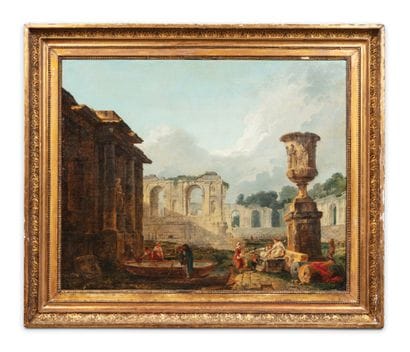
Architectural Ruins and Figures
on auction€100.000 - 150.000
TENTATION°2
Paintings
- artist
- Hubert Robert
- period
- 18th Century
- materials
- Oil paint, canvas, gilded wood frames
- technique
- Oil on canvas
- dimensions
- 77 x 92 cm
- provenance
- Possibly collection of Jean-Antoine Hubert Vassal (1741-1782), known as Vassal de Saint-Hubert, farmer-general and ordinary maître d'hôtel to Monsieur, brother of the King, in Paris; Possibly the pair mentioned as no. 63 in his estate sale, April 24, 1783, at Me Brusley, Paris; Possibly acquired by Nikolai Nikititch Demidoff (1773-1828) and his wife Elizaveta Aleksandrovna Stroganova (1779-1818) during their stay in Paris, before 1812; Possibly transmitted by descent and inheritance to their great-granddaughter Aurore Demidoff (1873-1904), wife of Arsène Karageorgevitch (1859-1938), Prince of Yugoslavia; Collection of Prince Paul Karageogevitch (1893-1976), Regent of Yugoslavia, son of the above, and his wife Princess Olga (1903-1997), née von Schleswig-Holstein-Sonderburg-Glucksburg ("of Greece"); Acquired directly from them by a close friend, a Greek diplomat stationed in France, in 1975; Then by descent to the present day.
A pair of oil on canvas paintings by Hubert Robert, one signed on the pedestal of the vase. They depict architectural ruins and figures, presented in beautiful early 19th-century gilded wooden frames decorated with pearls, water leaves, and acanthus leaves. Annotations in ink, likely from the late 18th century, are found on the back of each canvas: "n°6569 bis". The stylistic vein recalls Hubert Robert's debt to Gian Paolo Panini, and this pair is a superb example of the anti-mania taste particularly in vogue among the painter's Russian clientele. Robert presents a harmonious and highly characteristic example of his architectural entanglements. One painting features a fountain, circus, and monumental vase, which bears a strong resemblance to the Schouvaloff vase engraved by Piranesi and the Borghese vase. Its pendant depicts ruins of the colonnade of the Temple of Jupiter, as well as a fragment of a relief for an honorary monument representing Marcus Aurelius as Pontifex Maximus, sacrificing to Capitoline Jupiter, which was once visible in the church of Saints Luke and Martina. Robert's friendship with Madame Geoffrin, Empress Catherine II's epistolary correspondent, allowed him to gain recognition from Russian clientele in the early 1770s. This led to commissions from figures like Count Alexander Sergevitch Stroganoff, establishing a sincere friendship and access to a wealthy new clientele for the painter.