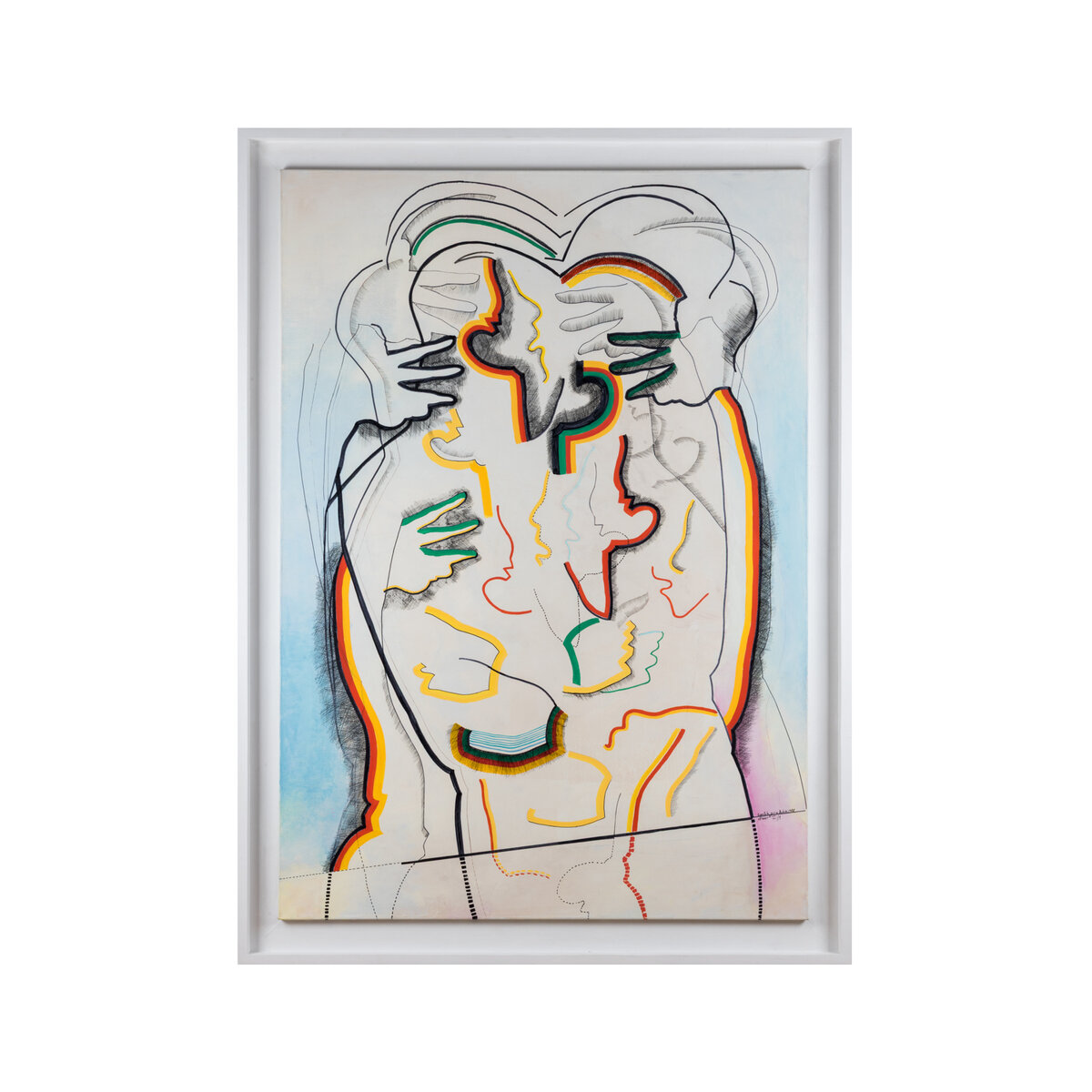
Paar I/1 1988
available1 100 000 Kč
Paintings
- artist
- Čeněk Pražák
- period
- 1988
- technique
- Oil on canvas
- dimensions
- 170 × 120 cm
- provenance
- From the author's estate, Galerie Weinberg
Čeněk Pražák (1914 – 1996) was a sculptor, architect, graphic artist, painter, illustrator, typographer, and photographer. From 1961–1964, he was a member of the Máj 57 group. From 1969, he lived in exile in Switzerland. In his youth, he painted and learned to play the violin. From 1930, he privately studied painting, first with Art Nouveau painter Karel Peterka, a friend of Luděk Marold. He became a member of the water scouts, where he befriended Prince M. Lobkowicz. In 1934, he stayed in Paris, and from 1936–1939, he served in the army. In 1942, he met painter Ladislav Bradáč (1885–1949), with whom he privately studied painting until 1949. Bradáč was a friend of Bohumil Kubišta and had a large collection of pre-war modern art. Pražák also educated himself in the history of world non-European and French art. From 1942, he worked as an illustrator and designer of book covers and record sleeves for several publishers (Čin, Máj, Orbis, Fr. Borový, Klapka, Svoboda, Artia, Mladá Fronta, Supraphon). Together with Bradáč and Jaroslav Hošek, he prepared a monograph on Otakar Marvánek for the publisher Čin. After the communist coup, he lost the opportunity to earn a living as an illustrator because private publishing houses ceased to exist. From the Swiss magazine Graphis, he learned with a five-year delay that his cover for Skořepa's poetry collection Orfeus won an award in 1946 at the exhibition "The Art of the Book Jacket" at the Victoria and Albert Museum in London. He befriended František Tichý, whom the communists fired from his professorship at UMPRUM. Together with his second wife Anna, he worked in a factory as a doll decorator. In 1955, Pražák lost his membership in the Union of Czechoslovak Artists, but was still allowed to work for the Práce publishing house. František Tichý arranged illustrations for him for the Odeon publishing house and passed on a commission to decorate the Bethlehem Chapel (1954). In 1958, Pražák and Tichý prepared joint designs for Expo 58, which were not realized. In the 1960s, he systematically devoted himself to painting. In 1960, he became a member of the Máj 57 art group and exhibited with them in 1961 in Poděbrady and in 1964 in Nová síň. In 1961, the Ministry of Culture bought his painting Blue Cathedral. At the Spring '62 exhibition in Mánes, his painting "Astonishment over the Universe" caused outrage, but in the end, it was only relocated and did not have to be taken down. In 1964, he had his first solo exhibition at the Gallery on Karlovo náměstí and was re-admitted to the Union of Czechoslovak Artists. He won the third prize of the Mladá fronta publishing house and in 1966 a bronze medal at the Leipzig Book Fair for illustrations for Čapek's book War with the Newts. In 1965, he was able to travel abroad for the first time and visited Munich. He befriended Jiří and Běla Kolář and, thanks to their intervention, was able to travel to the Venice Biennale. He was represented at the Spring Exhibition in Mánes (1966) and organized the 1st Prague Salon. In 1967, he was represented at the exhibition of the Block of Creative Groups (1967) and at an exhibition in Sopot. Together with the Austrian association März, he organized an exhibition of the Máj group in Linz. The following year, at the März association exhibition in the Gallery of the Čapek Brothers, he met sculptor Alfred Gruber and his wife Jacqueline, who then offered him asylum in their home in 1969 after his emigration to Switzerland. After the occupation of Czechoslovakia in August 1968, which he experienced personally near Prague, he decided to go abroad. In 1969, he still organized the exhibition "Artisti contemporanei di Praga" at the Museo Civico in Bologna, which was repeated at the Galerie Riehentor in Basel. Jiří Kolář took over the organization of the 2nd Prague Salon for him. In September, he emigrated with his wife via Austria to Switzerland, where he had his first solo exhibition in 1970. His friends managed to smuggle Pražák's violin across the border. In 1974, he became a member and from 1978, concertmaster of the chamber orchestra in Laufental-Thierstein. He was a member of the Riehentor galleries in Basel and Ernst Scheidegger in Zurich, and in 1983 he was elected to the presidium of the Swiss Society of Sciences and Arts. In his painting, he started from figuration and followed expressive and cubist tendencies from the beginning of the 20th century. In the 1960s, he simplified the figure to an artistic sign and created non-representational abstract compositions composed of geometric elements in the form of a pictorial collage. He also used the frottage technique and plastic processing of painting material. His constructivist abstract work in exile is characterized by the form of parallel organic lines in contrasting colors, which are effectively used as a dynamic element in a number of architectural realizations. His design work also influenced his free painting, in which he returned to figuration. This was strongly influenced by pop art. Characteristic is the unification of space through repetitive colored parallel lines that plastically depict figures. The compositions depict specific human situations (Figurative Projection, 1973). The overall impression of the painting is both lyrical and dramatic.