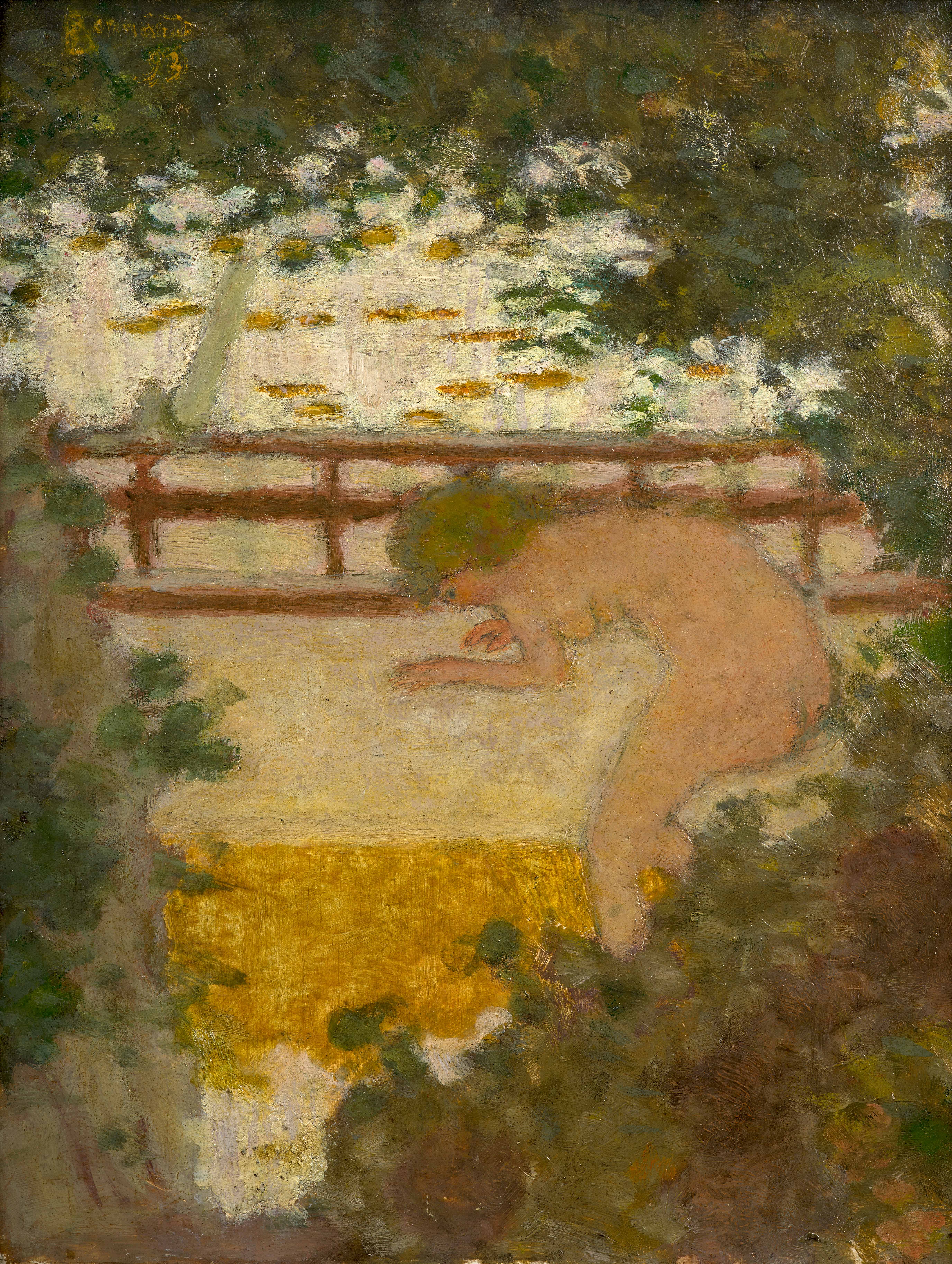
La Baignade de Marthe
on auction€150,000
Paintings
- artist
- Pierre Bonnard
- period
- 1893
- technique
- Oil and pencil on panel
- dimensions
- 35.2 cm x 27 cm
- condition
- Condition report
- provenance
- Thadée Natanson, Paris; Sale Paris, Hôtel Drouot, Me Baudoin, June 13, 1908, lot 2; Galerie Bernheim-Jeune, Paris (acquired from the latter); Adams Brothers Collection, London, 1937; A. Harpman Collection; Rosemary Peto Collection, Bembridge, Isle of Wight (acquired in 1949); Sale London, Christie's, December 8, 1999, lot 9; Galerie Neffe-Degandt Fine Art, London; Private collection, New York (2001); Sale New York, Sotheby’s, November 6, 2015, lot 203; Acquired at this sale by the current owner; Louis Grandchamp des Raux Collection
Signed and dated top left "PBonnard /93". In 1951, Thadée Natanson published a work in which he revisited the descriptions of the nineteen paintings by Bonnard that he had been 'forced' to sell in 1908. This one is described as follows: "". This passage highlights the narrative dimension of the work in its interpretation of the female figure’s leaning posture at the moment just before she dives into the water. Bonnard’s model was most likely his muse Marthe, whom he had met in 1893, the year this painting was created (ill. 1). With her reserved and introverted nature, she was the exact opposite of Misia. An employee in a shop selling artificial flowers, she went by the name of Marthe de Méligny, concealing a more humble identity: that of Maria Boursin, thirty-four years old and born into a modest family in Berry. Bonnard married her in 1925 and was deeply affected by her death in 1942. Marthe was a favourite model, notably for the series of nudes that brought the painter fame (ill. 4). In, Marthe appears as an almost mythological figure, suggesting a nymph ready to slip into the water, much like the ethereal heroines who populate the Symbolist plays of Maeterlinck, an author who was greatly admired by the Nabis at the time. The young woman moves towards a pool whose surface captures the golden light filtering through the trees. Behind her, the railing of a bridge crosses the scene, whilst a small sailing boat glides away towards a sparkling sea. As in many of his early works (ill. 2 and 3), Bonnard, nicknamed the 'very Japanese Nabi', organises his composition according to principles borrowed from Japanese prints. The abrupt rise in the viewpoint, the bold foreshortening, the supple line tracing the body and in particular, the delicate curve of the back, all draw upon Japanese art, and more specifically that of Utamaro. For Nicholas Watkins, this metamorphosis of Marthe into a nymph foreshadows the themes developed by Bonnard in his illustrations for, published in 1902. The artist approaches this nude with a new sensuality, just as his romantic relationship with Marthe was beginning. The young woman’s movement, as she leans towards the water, forms a single, long curve that unites her head, back and hips. The golden light, reflected by the pond, falls upon her skin, mingles with her hair and extends all the way to the bridge, unifying the scene in a single chromatic harmony. The curtain of foliage frames the composition like a natural window, placing the viewer in a slightly furtive, almost voyeuristic position, witnessing a moment of intimacy captured as it unfolds. Fig. 1 :, circa 1900-1901, negative on flexible gelatin silver film Fig. 2 : Pierre Bonnard,, 1893, oil on canvas Fig. 3 : Pierre Bonnard,, circa 1892, oil on wood, Private collection, Switzerland Fig. 4 : Pierre Bonnard,, oil on canvas, Royal Museums of Fine Arts of Belgium, Brussels