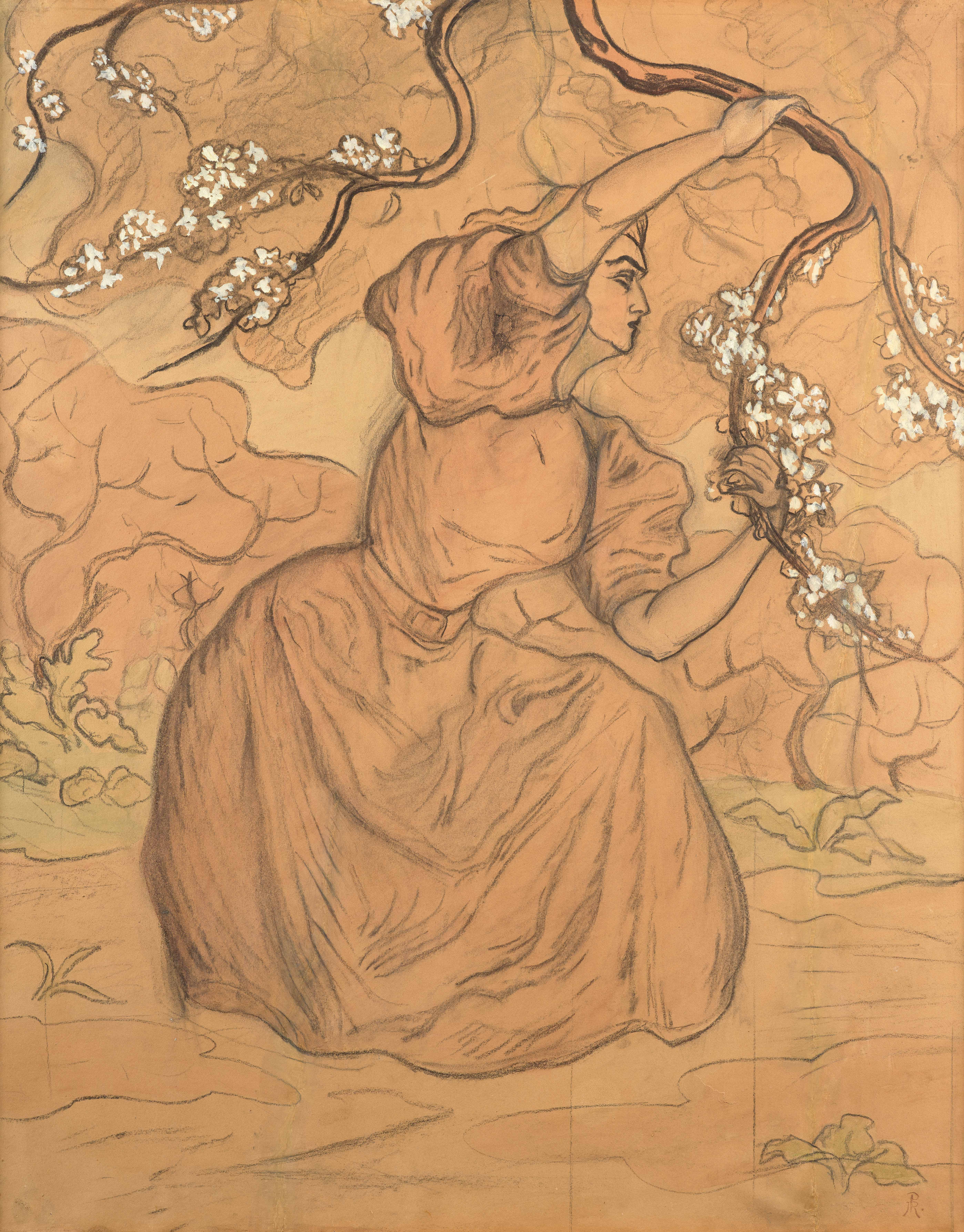
Femme accroupie, étude pour Femmes sous les arbres en fleur ou Le Printemps
on auction€40,000 - 60,000
Paintings
- artist
- Paul Ranson
- period
- 1895
- technique
- Charcoal, watercolor, and gouache on paper laid on canvas
- dimensions
- 76.2 cm x 61 cm
- provenance
- Artist's studio, then by descent; Galerie Bérès, Paris; Acquired from Galerie Bérès by the current owner in October 2016; Louis Grandchamp des Raux Collection
By the mid-1890s, Paul-Élie Ranson had produced a very diverse body of work comprising as much stained-glass windows as designs for tapestries and wallpaper, engravings and illustrations. Like his contemporaries Denis, Bonnard, Vuillard and Roussel, he was interested in the decorative arts, driven by a desire to break down the long-standing hierarchy between fine art and applied art. Our gridded drawing is a preparatory sketch for the very large work, a full-size study for the tapestry of the same subject. The cartoon was exhibited at the 18th Exhibition of the Society of Independent Artists, in the Grandes Serres at the Exposition Universelle in Paris. It allowed for the creation of a needlepoint tapestry, which was successfully exhibited at the 19th Salon of the Société Nationale des Beaux-Arts at the Champ-de-Mars (N°. 327) in 1897, and the following year in Brussels for the 5th Exhibition of the Libre Esthétique at the Musée d’Art Moderne (N°. 294). It was then presented at the Maison Moderne de Meier-Graefe until 1900. In her critical review of the Salon of 1897, Camille Mauclair acknowledged the role played by Ranson in the renewal of tapestry-making: ’ It was France Ranson, the artist’s wife, who produced the actual tapestry offrom her husband’s drawing. To date, only around ten of the couple’s completed needlepoint tapestries have survived. Alongside ranks among the most remarkable works in the artist’s oeuvre. There, France Ranson displays her mastery of the straight stitch, whose minute undulations lend the surface a singular density and vitality, characteristic of the entirety of the couple’s production. The technique, of the utmost delicacy, creates a subtle quivering of the fabric, akin to a pointillist vibration that animates the weave.