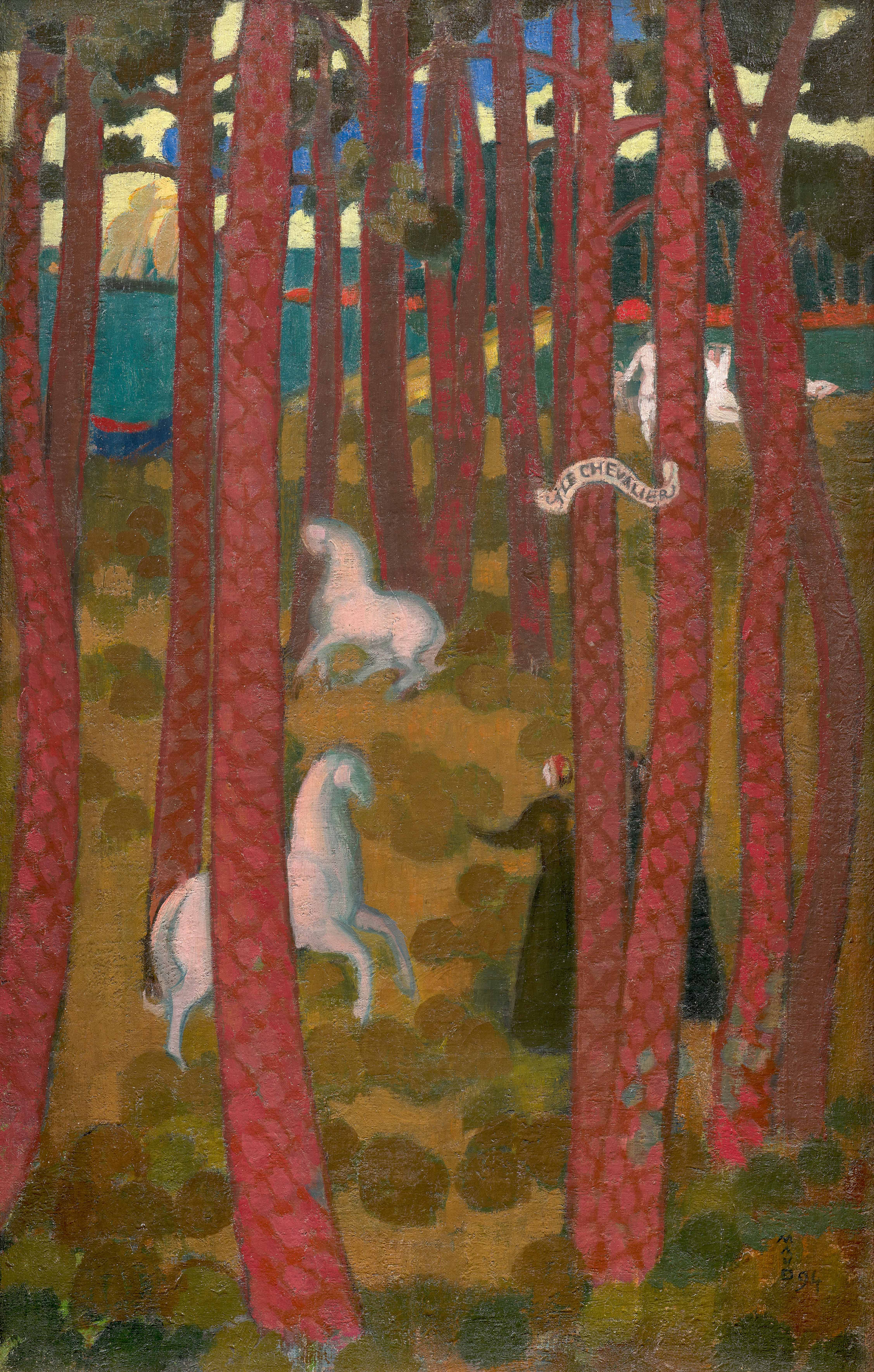
L'Île Chevalier
on auctionPrice on request
Paintings
- artist
- Maurice DENIS
- period
- 1894
- materials
- Oil on canvas
- technique
- Oil painting
- dimensions
- 57 cm x 36.5 cm
- provenance
- Galerie Vollard, acquired from the artist in a lot of 31 works, February 1899 (1,500 frs for the set; CDV 230; stock book A: n° 4034, then stock book B: n° 3708) Collection Madeleine de Galéa (1874-1956), née Moreau, by inheritance Collection Robert de Galéa (1894-1961), her son, Paris Collection Christian de Galéa (1917-2016), his son Private collection (acquired in the late 1960s) Galerie Wildenstein, New York Grosvenor Gallery, London Private collection, France (2022) Galerie Ary Jan, Paris Acquired from the latter by the current owner on December 1, 2023 Collection Louis Grandchamp des Raux
It was following a trip to Loctudy, in the Finistère, where he was staying with his wife in the summer of 1894, that Maurice Denis painted this work. This immersion in Brittany proved particularly fruitful: fuelling the inspiration for several other works, including(Musée de Pont-Aven) (ill. 1), which alludes to a local tradition, and(ill. 2), both painted during this period. The artist would later return to Loctudy with his family in 1901. During this first stay, Denis also visited Île Chevalier, situated in the estuary of the Pont-l’Abbé river. The ruins of a medieval manor house, known as “Château Gradlon”, caught his attention and inspired the motif of the horse, which he reused that same year for a stained-glass window commissioned by the art dealer Siegfried Bing. In the background, a seawall built in the 19th century connects the island to the shore. Its tip juts out into the southern part of the estuary, where boats glide by. Near the water, three distant figures dressed in white depicted standing, sitting and then lying down, can be interpreted as bathers, a recurring subject in Denis’ work. In contrast the white horses and the two figures in the foreground, wearing headdresses and long brown robes, give the scene a medieval atmosphere. This impression is reinforced by the presence of a scroll above their heads, as well as by the term “” within it, which, although it refers to the name of the island, evokes an ancient imagery. As with, (lot 28) painted the previous year, Denis places the title of the work in a floating cartouche, bestowing it with a dimension that is both sacred and unashamedly medieval. The whole can be understood as a symbolist interplay based on the contrast between two sensibilities. In the distance appears the signs of modernity and civilisation – the seawall, the sailing ship, the bathers, what could be a small boat in blues and reds – while at the centre of the island, within the woods, persists the hazy memory of a more ancient world, full of mystery, suggested by the strange marks visible at the base of the tree trunks. The artist placed his scene in the heart of the majestic pine forest that covered the island. These imposing trees with their red trunks structure the composition without interrupting its unity, giving the landscape a dream-like quality. This detailing of the trees in this manner can be found in other works by the artist; inor(1893, Private Collection) (ill. 3) executed the year before. Passionate about nature, particularly trees, Denis has them as recurring protagonists in his œuvre. Here they play a leading role, dominating the human figures, whose activity seems trivial in the face of their ceremonial presence. Their composition is unique: the massive, centrally positioned trunks occupy most of the space, whilst the roots are absent and the foliage, relegated to the upper part of the composition, is merely incidental. True mediators between heaven and earth, they create a cathedral-like architecture that organizes the space and lends depth and structure in the absence of linear perspective. Maurice Denis clearly remembered Gauguin’s advice to Sérusier, which he himself had recorded: “” (ill. 4). True to this lesson, his trees are coloured, as in(1893),(1913) and(1900). In our painting, the trees, marbled with red, bear no trace of the passing of time; their timeless and legendary quality accentuates the “medieval” mystery that moves through this work.